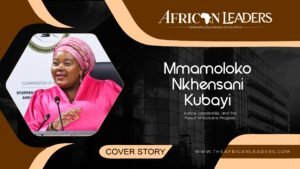
Mmamoloko Nkhensani Kubayi: Justice, Leadership, and the Pursuit of Inclusive Progress
Public leadership carries a unique responsibility. Every decision has the potential to shape institutions, influence public trust, and improve the lives of millions. In a nation as dynamic and diverse as South Africa, that responsibility becomes even greater. Building stronger governance, protecting constitutional values, expanding economic opportunities, and ensuring equal access to justice require leaders who can navigate complexity while remaining connected to the everyday realities of the people they serve.
Among the leaders who have consistently carried that responsibility is Mmamoloko “Nkhensani” Kubayi, a respected South African stateswoman whose career reflects both depth and versatility. Currently serving as the Minister of Justice and Constitutional Development and a Member of Parliament of the Republic of South Africa, she has played an instrumental role in shaping policies across several of the country’s most significant government portfolios. Her leadership journey has included serving as Minister of Energy, Science and Technology, Tourism, and Human Settlements, each appointment broadening her understanding of the interconnected challenges that influence national development.
During one of the country’s most demanding periods, Kubayi also served as the Acting Minister of Health during the COVID-19 pandemic, where her leadership and commitment to strengthening South Africa’s vaccine rollout earned widespread recognition. Today, as Co-Chairperson of the Justice, Crime Prevention and Security (JCPS) Cluster in Cabinet, she continues to guide national efforts focused on justice, constitutional governance, and public safety. Her previous role as Co-Chairperson of the Cabinet’s Economic Cluster further reflects her experience in driving policies that balance economic growth with social progress.
Beyond her ministerial responsibilities, Kubayi remains an influential figure within the African National Congress (ANC), serving as a member of both the National Executive Committee (NEC) and the National Working Committee (NWC). Her tenure as Chairperson of the ANC’s Economic Transformation Subcommittee highlights her longstanding commitment to advancing inclusive development and creating policies that address South Africa’s enduring social and economic inequalities.
Recognised as “Africa’s Fearless Woman Leader,” Kubayi has built her public service career on the belief that meaningful leadership is measured not by authority alone, but by the ability to create opportunities, strengthen democratic institutions, and bring people together in pursuit of lasting national progress. Her journey reflects a steadfast commitment to constitutional governance, social justice, and a vision of a more united and prosperous South Africa within a stronger African continent.
A Leadership Philosophy Rooted in Collective Progress
Kubayi’s understanding of leadership did not begin in politics. It was built through years of working alongside communities and organisations dedicated to creating lasting social impact.
After graduating from university, she began her professional journey as an intern at a non-governmental organisation focused on community organising, urban conflict resolution, and socio-economic advocacy. Working closely with vulnerable communities gave her firsthand insight into how grassroots organisations can improve lives, particularly in underserved areas where access to opportunity remains limited.
Her transition into the private sector as a skills development specialist within the banking industry introduced another dimension of development. The role placed her at the centre of workforce development for the financial sector, offering a deeper appreciation of how economic growth depends on investing in people and building capabilities.
Her perspective expanded further after joining the National Health Laboratory Service as a skills development facilitator. There, she witnessed the importance of collaboration between public institutions and private organisations in addressing national priorities and strengthening service delivery.
A defining chapter followed when she was appointed Director in the Office of the Deputy President under then Deputy President Phumzile Mlambo-Ngcuka. The position involved coordinating partnerships between government, business, and civil society to deliver community development initiatives across South Africa. Working across these sectors reinforced a belief that sustainable progress depends on cooperation rather than isolated efforts.
These experiences continue to shape her leadership philosophy, which she believes is best reflected in the African proverb: “If you want to go fast, go alone. If you want to go far, go together.” For Kubayi, lasting change has always been built through partnerships, shared responsibility, and a commitment to collective progress.
Fearless Leadership Through Inclusion
Receiving recognition as “Africa’s Fearless Woman Leader to Follow in 2026” carries a significance that extends beyond personal achievement. For Kubayi, fearless leadership is measured by the willingness to challenge systems that continue to deny equal opportunity and dignity to others.
She believes courage begins with confronting structures of illegitimate power that prevent inclusive development, particularly those that continue to disadvantage women and young people. In her view, one of the most deeply rooted forms of unequal power remains the social and institutional structures that have historically privileged men over women.
Kubayi argues that genuine leadership requires questioning these long-standing norms rather than accepting them as permanent realities. She believes that creating a truly inclusive society cannot happen while women continue to face systemic barriers or are treated as second-class citizens.
Her understanding of fearless leadership therefore extends beyond political decision-making. It involves consistently advocating for fairness, creating opportunities for those who have traditionally been excluded, and ensuring that development benefits every segment of society rather than a privileged few.
Understanding Government Through Multiple Perspectives
Few public leaders have managed as many diverse portfolios as Kubayi, each carrying unique responsibilities while contributing to South Africa’s broader development agenda.
Serving across Energy, Communications, Science and Technology, Tourism, Human Settlements, and Justice has given her a comprehensive understanding of how different sectors depend on one another. Rather than viewing government departments as separate entities, she sees them as interconnected parts of a much larger system where progress in one area often relies on success in another.
These experiences have strengthened her ability to identify the links between policy, economic growth, institutional capability, and public service delivery. Every portfolio, regardless of its focus, has reinforced the importance of developing sound public policies supported by capable institutions and a workforce equipped to deliver meaningful outcomes.
At the same time, she believes that policies alone cannot transform societies. Effective governance also depends on political commitment and the willingness to implement decisions that address real public needs. Managing diverse ministries has therefore broadened both her strategic perspective and her understanding of how complex national challenges require coordinated solutions across multiple sectors.
Choosing Governance Over Political Convenience
Public leadership often demands decisions that attract intense scrutiny, particularly when legal, political, and public interests intersect. One of the defining moments in Kubayi’s career came during her first Cabinet appointment as South Africa’s Minister of Energy.
At the time, the government had committed to pursuing a nuclear power programme to strengthen electricity generation. The decision quickly became the subject of widespread public debate and legal challenges.
The situation reached a turning point when the Western Cape High Court ruled in favour of Earthlife Africa and the South African Faith Communities’ Environment Institute, declaring the government’s nuclear procurement agreements with Russia, the United States, and South Korea unlawful and unconstitutional.
Although Cabinet held a different view, Kubayi decided not to appeal the judgment. Her decision was not driven by opposition to nuclear energy itself. Instead, it reflected her belief that the procurement process had failed to meet the legal standards of transparency, accountability, and good governance. She concluded that defending an unlawful process would undermine the principles that public institutions are expected to uphold.
Looking back, she considers that decision an important affirmation of constitutional governance and the rule of law. It reinforced her conviction that leadership sometimes requires choosing institutional integrity over political convenience.
Expanding Opportunities Through Inclusive Procurement
Among the many portfolios she has overseen, Kubayi identifies her work in Human Settlements as one of the most meaningful opportunities to create lasting economic inclusion.
During her tenure, the department introduced and implemented a mandatory 40 percent procurement set-aside for designated groups, including women, young people, persons living with disabilities, and military veterans.
The policy was designed to address long-standing barriers that limited participation by these groups in government procurement and economic activity.
By the time she moved to her current portfolio, the initiative carried an annual allocation target of R8.33 billion. During the first three quarters of the 2023 financial year alone, designated groups had already received R2.057 billion through the programme.
Beyond the financial figures, Kubayi believes the policy created meaningful opportunities for entrepreneurs who had previously struggled to build sustainable businesses. Women and youth-owned enterprises, many of which faced exceptionally high failure rates before the programme’s introduction, gained improved access to government contracts and greater prospects for long-term growth.
She views the initiative as evidence that carefully designed public policy can become a practical tool for economic empowerment, creating opportunities that strengthen businesses while contributing to broader social and economic development.
Balancing Immediate Needs with Long-Term National Progress
Public leadership often requires navigating two equally important responsibilities: addressing the urgent concerns of citizens while laying the groundwork for sustainable national development. Kubayi believes these objectives are not separate but deeply connected.
Her leadership has also been shaped by her willingness to serve at the forefront of some of the country’s most challenging periods. From responding to the COVID-19 pandemic, to contributing to the Economic Recovery and Reconstruction efforts aimed at reviving the economy and rebuilding livelihoods in its aftermath, and now confronting the complex challenges associated with migration, she has continued to engage with issues that require decisive leadership, adaptability, and a strong understanding of their impact on communities. These experiences have reinforced her belief that leadership must remain responsive to the realities facing society while also anticipating emerging challenges and developing sustainable solutions.
Her approach is determined by the vision of the African National Congress, an organisation committed to transforming South African society by addressing the economic and social inequalities inherited from apartheid. Throughout every leadership position she has held, that mission has remained a constant point of reference.
Combating poverty and unemployment has therefore remained central to her work. She views these challenges as the most immediate concerns facing many South Africans, and believes government has a responsibility to deliver practical solutions that improve people’s daily lives while creating opportunities that benefit future generations. In her view, meaningful development begins by responding to present realities without losing sight of the country’s long-term aspirations.
Guiding Africa Through the Age of Artificial Intelligence
Having served on international platforms such as the World Economic Forum’s Global Artificial Intelligence Council, Kubayi has had the opportunity to engage with conversations shaping the future of technology and governance. While she recognises the transformative potential of emerging technologies, she also believes their impact must be approached with careful responsibility.
Technology has always played a defining role in advancing societies, strengthening economies, and improving public services. Artificial intelligence, however, presents a different kind of challenge because of its ability to replace human labour across multiple sectors. While AI offers enormous opportunities to improve productivity and government service delivery, it also raises concerns about employment, economic inclusion, and widening inequality.
Kubayi believes these realities place an important responsibility on today’s leaders. Strong governance frameworks, ethical oversight, and forward-looking public policies will be essential to ensure technological innovation benefits society rather than creating new forms of exclusion.
She sees responsible leadership as the key to ensuring artificial intelligence serves humanity while reducing the risks that accompany rapid technological change.
Resilience Built Through Challenging Established Barriers
Serving in some of South Africa’s most influential leadership positions has given Kubayi both opportunities and challenges. Throughout her career, she has worked within systems where gender inequality continues to influence access to leadership and decision-making.
She acknowledges that South Africa, like many societies, continues to face the realities of patriarchy, where opportunities for advancement often favour men. While she considers herself fortunate to belong to a liberation movement that has consciously promoted women’s representation within Parliament and the Executive, she recognises that broader societal attitudes continue to shape institutional culture.
Those experiences have strengthened rather than discouraged her resolve. They have reinforced her commitment to challenging structures that continue to grant men advantages simply because of gender, while demonstrating through her own work that women are equally capable of leading complex institutions and driving national development.
Her resilience has therefore grown not only from overcoming personal obstacles but also from a determination to create greater opportunities for future generations of women leaders.
The Qualities Africa’s Next Leaders Must Possess
Kubayi believes Africa’s future leadership will be shaped by the continent’s greatest strength, its young and rapidly growing population. As younger generations assume greater leadership responsibilities, she expects they will bring new ideas, greater innovation, and stronger expectations for Africa’s place within the global economy. Yet she believes enthusiasm alone will not be enough.
Tomorrow’s leaders will need strong educational foundations, but education must not be understood as something that ends with a qualification. Kubayi regards lifelong learning as an essential quality of effective leadership, particularly in a world where technology, economies, societies, and public policy are changing at unprecedented speed. Leaders must remain curious, willing to listen, open to new knowledge, and prepared to continuously develop their understanding of the challenges they are called upon to address. Education provides the foundation for informed leadership, while lifelong learning enables leaders to adapt, innovate, question established approaches, and make better decisions in the interests of the people they serve.
Equally important is a deep understanding of the people they serve and the communities they represent. For Kubayi, effective leadership therefore combines knowledge with humility, continuous learning with practical experience, and strategic thinking with an enduring commitment to service.
She also believes future African leaders must embrace Pan-Africanism, recognising that the continent’s long-term success depends on greater cooperation, shared development, and a collective vision that extends beyond national borders.
A Vision of an Integrated and Prosperous Africa
Looking toward 2030, Kubayi sees South Africa’s future as inseparable from the progress of the African continent as a whole. She aligns closely with the African National Congress’ long-standing vision of building a united, non-racial, democratic, and prosperous South Africa. Beyond national priorities, she also supports the broader goal of advancing African integration and sustainable development across the continent.
Her vision includes stronger regional cooperation, continued support for peace-building initiatives, expanded intra-African trade, and greater implementation of the African Continental Free Trade Area (AfCFTA). She believes these priorities will help unlock economic opportunities while strengthening unity among African nations.
Eventually, she sees inclusive growth not simply as an economic objective but as the foundation for a more stable, connected, and prosperous Africa where development is shared across borders and communities.
Inspiring Young Women to Lead Through Service
Kubayi encourages young women interested in politics, governance, and public administration to rethink what leadership truly means. In her view, leadership is not defined by titles or positions but by a genuine commitment to improving the lives of others.
She believes leadership begins wherever people choose to take responsibility for the challenges facing their communities, whether within schools, workplaces, neighbourhoods, or local organisations. Every opportunity to solve problems and support others contributes to developing the qualities needed for public leadership.
While she considers formal education essential, she also believes no classroom can replace the understanding gained by working directly with communities. Listening to people, understanding their realities, and participating in efforts to address their challenges provide lessons that shape compassionate and effective leaders.
Her message to young women is clear: meaningful leadership starts long before holding public office, and it grows through consistent service to others.
A Legacy Defined by Equality and Courage
When reflecting on the legacy she hopes to leave behind, Kubayi speaks less about positions held and more about the principles that have guided her throughout public life.
She hopes future generations will remember her for a fearless and unwavering commitment to achieving substantive equality for all South Africans. Whether through policy, public service, or political leadership, she wants her contribution to be measured by efforts to dismantle the enduring legacy of apartheid and build a society founded on fairness and equal opportunity.
Her vision extends beyond South Africa. She also hopes to contribute, however modestly, to the creation of a united, non-racial, non-sexist, democratic, and prosperous South Africa while supporting the broader aspiration of a stronger and more united Africa.
It is a legacy rooted not in personal recognition, but in the belief that lasting leadership is ultimately measured by the opportunities created for future generations and the positive change left behind.
Read Also: Dr. Walton Gilpin: Banking Beyond the Balance Sheet