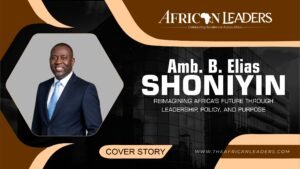
Elias Shoniyin: Reimagining Africa’s Future Through Leadership, Policy, and Purpose
Across Africa, the conversation about development is gradually shifting from aspirations to implementation. Governments, universities, development institutions, and private organizations are increasingly looking for leaders who can connect policy with action, research with real-world impact, and diplomacy with long-term national progress. The continent’s future will be shaped not only by economic growth, but by the quality of its institutions, the strength of its leadership, and the ability to build solutions rooted in African realities.
Elias Shoniyin, Managing Director and Managing Partner of Africa Development Management Associates (ADMA), has spent more than two decades working at the intersection of international affairs, diplomacy, public policy, and development to help drive that transformation.
With over 23 years of experience across academia, government, and international development, Elias has built a career dedicated to strengthening institutions and advancing evidence-based decision-making across Africa. As the Dean of the School of Global Affairs and Policy at Cuttington University, he has helped shape academic programs and research in development policy, public administration, and international relations. Through ADMA, he leads strategic advisory, project management, and capacity-building initiatives for public and private sector organizations across the continent, with a focus on economic self-reliance, public sector transformation, security sector reform, human rights, and peacebuilding. His work reflects a consistent commitment to helping African institutions move beyond vision statements toward measurable and sustainable progress.
A Future-Focused Vision for Africa
Elias has built a career across diplomacy, academia, public policy, and development consulting with a single conviction: Africa’s future depends on the choices it makes today. He believes deeply in the continent’s potential, but also insists that potential alone is not enough. Progress must be driven by leadership, strong institutions, knowledge, and deliberate action.
What continues to drive him is the need for a different development conversation, one that looks ahead rather than remaining anchored in the past. While he acknowledges the lasting impact of colonialism, he argues that Africa must also examine its own decisions and responsibilities. In his view, history cannot be changed, but the future can still be shaped through courage, accountability, and purposeful leadership.
Turning Experience into Practical Solutions
Africa Development Management Associates (ADMA) was born from conversations between Elias and Dr. Toga Gayewea McIntosh about how decades of experience in government, diplomacy, and international development could be transformed into practical solutions for the continent.
The organization was created to help bridge the gap between development ambitions and implementation. Its work spans research, policy and strategic advisory services, institutional capacity building, international cooperation, and development programming. ADMA’s approach is rooted in a simple belief: Africa’s challenges require rigorous, context-specific solutions grounded in local realities. The goal is not only to produce strategies, but to help institutions create measurable improvements in people’s lives.
The Discipline of Trust, Judgment, and Execution
His years in diplomacy and development consulting have shaped a leadership philosophy grounded in relationships, judgment, credibility, and execution. Diplomacy taught him that leadership is ultimately about people, while development work reinforced that good intentions have little value without implementation.
Having worked through negotiations, institutional reform, development financing, and competing national priorities, he learned the importance of listening carefully, questioning assumptions, building coalitions, and staying focused on outcomes.
Elias considers trust the foundation of successful collaboration. Governments, businesses, development partners, and civil society often operate with different incentives, but lasting partnerships become possible when people believe that commitments will be honored and that the process is credible.
Trust must be supported by competence, transparency, evidence, humility, and the ability to listen. His diplomatic experience taught him that meaningful partnerships are built when leaders arrive prepared, understand the interests of others, and create an environment where every stakeholder can contribute toward a shared objective. He believes leadership rests on three principles: earning trust, understanding problems before proposing solutions, and never confusing a position of authority with genuine leadership.
The Real Development Challenge
In his view, Africa’s most significant development challenge is not simply infrastructure or financing, but a deficit in leadership, human capital, and institutional capacity. Roads and bridges matter, but they cannot replace educated, healthy, skilled, and productive citizens.
He argues that governments should focus on creating an enabling environment through the rule of law, education, energy, infrastructure, sound regulation, and stability, while allowing enterprise, innovation, and entrepreneurship to generate wealth and employment. Africa’s future, he believes, depends on moving beyond resource extraction toward economies that produce, process, manufacture, innovate, and trade competitively.
Universities as Engines of Transformation
After more than two decades in academia, Elias remains convinced that education is one of the most powerful instruments of transformation. Yet he believes African universities must move beyond simply awarding degrees and instead produce graduates capable of solving real problems.
Universities should connect classrooms with industry, government, communities, and technology, becoming laboratories for national development. Africa will not be transformed merely by building more institutions of higher learning, but by producing people capable of creating better governments, businesses, technologies, and institutions.
Making Evidence the Basis of Policy
He believes African governments must place research and evidence at the center of decision-making rather than searching for data after political decisions have already been made. Stronger statistical systems, better research units within ministries, partnerships with universities and think tanks, and clearer links between evidence, budgeting, and implementation are essential.
Governments must also become learning institutions that regularly ask what worked, what failed, and what should change. Africa’s challenge is not only a shortage of good policies, but the persistent gap between policy ambition, evidence, implementation, and accountability. Real development, he argues, accelerates when governments measure results rather than simply announce intentions.
Strengthening Africa’s Place in the World
Elias believes Africa’s influence on the global stage begins with credibility at home. In his view, no nation can command respect internationally while accepting weak institutions, corruption, injustice, and limited opportunities for its people.
He argues that stronger democratic and merit-based institutions, investment in human capital, respect for the rule of law, and broader economic opportunity are essential foundations of global influence. Africa must negotiate from clearly defined interests rather than from a position of dependency. Its natural resources, youthful population, markets, and geopolitical importance provide significant leverage, but that leverage is meaningful only when guided by capable leadership and strategic thinking. Respect, he believes, is earned through what nations build and how effectively they advance their interests.
A Crisis That Redefined Leadership
One of the defining moments in his career came during the Ebola crisis in Liberia. After returning to Monrovia from a foreign mission, he encountered sick people lying outside an overwhelmed Ebola treatment facility because there was no capacity to admit them. He immediately reported the situation to President Ellen Johnson Sirleaf, who convened senior health officials the next morning and asked him to describe what he had witnessed.
That conversation contributed to urgent measures, including the establishment of holding facilities across the country. The experience taught him that leadership cannot become captive to protocol during a crisis. When lives are at stake, leaders must speak uncomfortable truths, act quickly, and accept responsibility for difficult decisions. During the outbreak, he also coordinated Liberia’s international resource mobilization efforts through the Foreign Ministry.
Why Public-Private Partnerships Matter
He sees the private sector as central to Africa’s economic transformation because governments redistribute resources, while productive economies create them. Public-private partnerships, however, must go beyond contractual arrangements.
Governments need to create conditions that allow businesses to invest, innovate, expand, and generate employment. Reliable energy is particularly critical, as industrialization cannot occur without electricity. Africa’s long-term goal, he argues, should be economies where natural resources are increasingly processed within the continent, local businesses participate meaningfully in value chains, and workers develop globally competitive skills.
Advice to the Next Generation of Leaders
His advice to emerging leaders is direct: do not spend your life waiting for someone to offer you a seat at the table. If the opportunity does not exist, create one.
He encourages young Africans to replace entitlement with preparation, frustration with strategy, and complaints with competence. Leadership is rarely granted simply because it is deserved. It is built through relentless preparation, integrity, strong networks, calculated risk-taking, and resilience in the face of failure. The goal is not only to overcome barriers, but to become strong enough that those barriers lose their power.
A Decade of Building, Not Discussing
Looking ahead, Elias’ priority is to expand Africa Development Management Associates beyond West Africa and contribute more broadly to development challenges across the continent while helping develop a new generation of African development professionals.
He believes Africa’s transformation depends on four foundational commitments: quality education, accessible healthcare, the rule of law, and reliable energy. Every child should have meaningful access to education, every family should be able to obtain basic healthcare, the law should apply equally to all citizens, and affordable energy should power agriculture, industry, technology, and investment.
Africa, he argues, does not lack potential. It needs disciplined priorities, capable institutions, courageous leadership, and consistent implementation. The next decade should not be another period of discussing transformation, but one of deliberately building it.
Elias hopes his legacy will be measured not by the positions he held, but by the institutions he strengthened, the people he empowered, the opportunities he created, and the ideas he left behind.
Whether through diplomacy, teaching, public policy, mentoring, or the work of ADMA, he has sought to invest in efforts that can outlast his own career. To him, the greatest achievement of a leader is not becoming indispensable, but building people and institutions capable of succeeding long after that leader has departed. If future generations inherit stronger institutions and a more ambitious vision for Africa, he believes that would be a legacy worth leaving.
Read Also: Built on Grit, Backed by Purpose: The Multi-Industry Legacy of Tiaan Steijn