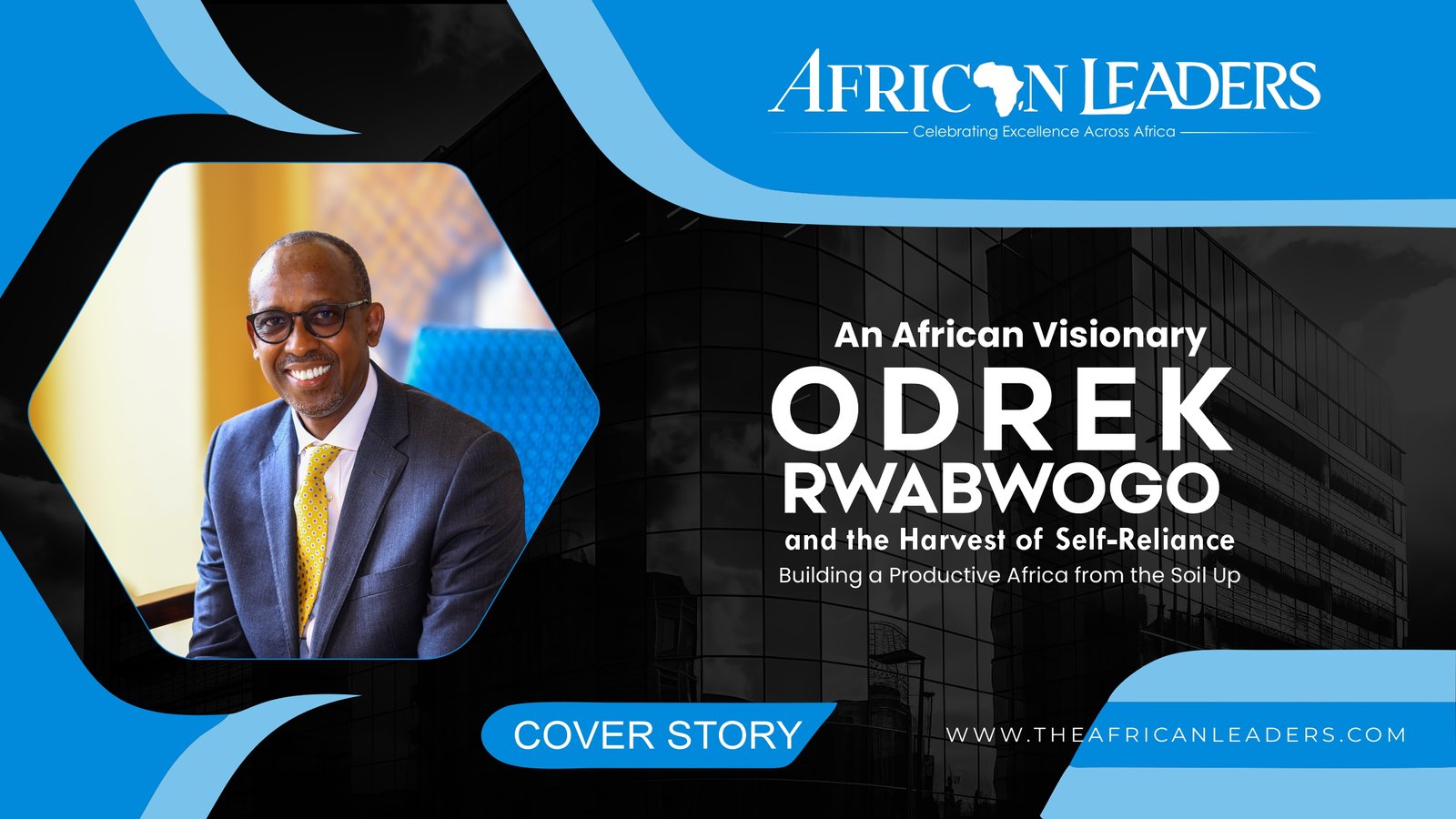
A quiet revolution is taking root. In the lush, rolling hills of western Uganda. Where the morning mist clings to the grazing lands. That revolution is not one of noise and slogans. It is of soil, sweat, and a fierce belief in what Africa can become. A man who moves between two worlds with a natural grace, Odrek Rwabwogo is as comfortable talking strategy in a boardroom as he is checking on the dairy herd at Tomosi’s Farm. Earning his place as one of the most impactful leaders to watch in 2026, known across the continent as a farmer and an entrepreneur, Odrek has emerged as a voice of reason and ambition.
His journey is deeply rooted in the land. At Tomosi’s Farm, he has turned a family legacy into a modern powerhouse that includes a technical school, a dairy plant, and a beef processing facility. For Odrek, farming is not just about food; it is about dignity and self-reliance. He has seen firsthand the struggles of the Ugandan agricultural sector, and he has made it his mission to fight for the industry and exports that will carry his country’s products to the rest of the world. He believes that Africa should not just be a source of raw materials, but a center of production and innovation. “True leadership is not about the titles we hold or the positions we fill. It is a selfless search for purpose and a commitment to building an economy that, like rising waters, lifts every boat to the shore. We must stop being just consumers of the works of others and start being the creators of our own future.”
As a Senior Adviser to the President, Odrek uses his influence to mentor the next generation. He spends much of his time teaching National Collective Values to young people, working to replace doubt with a grounded confidence in their African identity. A graduate of Makerere University and the University of Wales, he brings a sharp, analytical mind to the challenges of leadership communication. He runs frequent training seminars where he shares the hard-won lessons of sustaining a business in a developing economy, always pushing for excellence and transparency.
Beyond his public roles, Odrek is a celebrated author and a devoted father of four. His short stories capture the nuances of Ugandan life, reflecting a man who understands that a nation is built as much on its narratives as its numbers. He often speaks of the ‘loneliness of hard decision making,’ yet he continues to walk that path with a sense of duty. He is a man who believes that the ‘Made in Africa’ label should be a mark of global quality, and he is working every day to make that vision a reality for the farmers and entrepreneurs who follow in his footsteps.
The Wisdom of the Countryside
Odrek’s vision for a prosperous Africa was not born in a boardroom but in the fertile soil of the Ugandan countryside. Growing up in a peasant family, he learned the art of situational awareness long before he studied global markets. In the village, nature is a direct teacher, and the needs of the community are visible every day. His parents stood out because they did not just grow food to eat; they grew for the market. This early exposure to the difference between subsistence and income shaped his understanding of how a household moves from poverty to stability.
The journey to school was a ten-kilometer run every morning, often without the help of a textbook. In that environment, resilience was not a choice but a requirement for survival. He learned to sit at the feet of a few dedicated teachers, absorbing knowledge through listening and observation. This limited access to formal resources forced him to develop the ability to teach himself, a skill that would later allow him to master complex fields like finance and international trade despite not having a formal degree in those subjects.
Discovering the Power of Calling
A pivotal shift in his perspective occurred during his master’s studies in Britain. He encountered a lecturer who held only a diploma but was so successful in the private media sector that universities sought her expertise to teach students steeped in theory. This encounter revealed a profound truth: following a personal calling and mastering a talent can create more value than titles alone. It encouraged Odrek to look beyond conventional paths and bring out the diverse elements of his own character to make a difference.
Returning to a country recovering from the HIV/AIDS pandemic and political instability, he felt a deep sense of responsibility. He saw people with very little education working to rebuild a nation that many thought would fail. This environment made him realize that leadership is a service to the greater good. He recognized that while people are capable of greatness, they often struggle with a sense of selfishness, making the role of a mentor essential for collective success.
From Village Markets to Global Trade
Before entering public service, Odrek spent twenty years as a businessman, building an agricultural model that connected rural communities to urban centers. He quickly realized that domestic markets were too small to truly raise the production capacity of a village. To grow, he had to step out and present opportunities to equity funders, transforming primary commodities into high-value dairy products.
This transition taught him the harsh reality of the African financial ecosystem. While the continent is resource-rich, it remains cash-poor, often forced to use short-term money for long-term industrial solutions. Through PACEID, he now applies these lessons to help Ugandan exporters negotiate market entry and access low-cost funding. He uses research and the study of biographies to understand how other nations solved similar problems, turning historical lessons into modern strategies. He remains focused on the belief that a successful nation starts with a successful household, fueled by the discipline of adding value to what the land provides.
Bridging the Gap Between Farm and Global Market
Odrek believes that opening markets is a task that cannot be done blindly. In the last four years, his work has focused on thirteen key Ugandan products, with nearly half of these exports staying within East and Central Africa. He argues that success in these commodity markets requires more than just a product; it requires trade representation, strict adherence to global food safety standards, and the negotiation of lower logistics costs. To make this possible, he is pushing for the creation of digital platforms that combine government certification data with private sector trade information.
While technology like artificial intelligence evolves daily, Odrek remains grounded in the fundamentals of transportation, food, and human relationships. He views data as a tool to navigate the changing preferences of a growing population. For him, the real challenge is building a reliable bridge between the rural supplier and the international buyer, a moving target that requires constant adaptation.
Innovation as a Result of Execution
In the evolving African markets, Odrek sees innovation and execution as two sides of the same coin. He believes that every time a person takes a thought and turns it into an action, they are innovating and learning. This mindset allowed him to see opportunity where others saw waste. He points to the humble banana, of which Uganda produces millions of tons. By transforming surplus bananas into high-quality chips for school lunch counters, a business solves a waste problem while meeting a market need. “I have learned to see more where people see less, and to take nothing for granted. Innovation is not something you set out to do as a title; it is what happens when you support small businesses with capital and market entry. The more you execute, the more you grow.” He encourages young entrepreneurs to move beyond seeking government jobs and instead look at the raw materials around them. By providing funding to small enterprises led by women and youth, he aims to foster a culture where creative rigor is the standard. For Odrek, success is reflected in the ability to turn a primary commodity into a finished product that competes on the global stage.
Surfacing Reality to Build the Future
Leadership, according to Odrek, is the ability to speak about the unwelcome realities that others choose to ignore. He notes that much of the competition in Africa is still driven by external entities selling finished goods, while African businesses often struggle to export their own processed products. He believes that abundance can sometimes slow down innovation, but shifting demographics and new technologies are changing the landscape. Uganda is now exporting processed avocado oil and hundreds of millions of dollars in cocoa and chocolate, items that were not on the books a decade ago.
The path forward requires a massive shift in infrastructure. Odrek highlights the high cost of road transport, noting that moving a container from the coast to the interior can cost more than shipping it across an ocean. He advocates for a move toward rail and water transport to reduce costs. As the continent looks ahead, he sees a future where young people skip plastic cards and use mobile tools for every transaction. By using blockchain for export documentation and bringing financial tools to the last-mile farmer through cooperatives, he aims to ensure that Africa’s wealth remains in the hands of its people.
Metrics of Resilience and Human Connection
Odrek believes that the true measure of impact goes far beyond the simple scale of revenue. For him, the most vital metric is the number of businesses his initiatives can successfully onboard and restructure. He sees every failing business as an opportunity for transformation through better management and specialized skills. When a company is stabilized, it does not just save jobs; it creates a reliable buyer for thousands of local farmers. This ripple effect strengthens the entire community, turning a single intervention into a broader engine for economic health.
He is particularly focused on reclaiming value that has historically been lost to distant markets. For years, Ugandan coffee was shipped to Europe to be roasted and packaged before being sold back to neighboring African countries. PACEID, chaired by Odrek, is changing this by ensuring that roasting, branding, and packaging happen at home. By influencing these sectors, he ensures that the profits and the manufacturing jobs stay within the continent. He monitors how many new market segments Uganda can fill, moving from raw exports to shelf-ready products that compete with global brands. “Success is reflected when our companies can stand firm under pressure. We must move from being a country that simply supplies raw materials to one that exports finished goods. Every roasted coffee bean packaged in Uganda is a victory for our manufacturing sector and a sign of a maturing economy.”
Building Reputation Through Word of Mouth
De-risking Africa in the eyes of global financiers is a constant challenge, but Odrek views human contact as the most powerful tool for changing international perceptions. He believes that a genuine recommendation through tourism or business partnerships carries more weight than any expensive advertisement in a foreign capital. By communicating clearly about the quality and standards of Ugandan products, he builds a reputation based on trust. This organic growth in reputation attracts foreign direct investment by proving that African ventures are stable and high-achieving.
Advice for the Next Generation of Founders
For those looking to build ventures in Africa, Odrek points to the massive gaps in everything from electronics to electric vehicles as a landscape of novelty and opportunity. He urges entrepreneurs not to lose hope when capital is expensive or infrastructure is lacking. He advocates for a “charity begins at home” approach, encouraging founders to master regional markets like Kenya, DR Congo, and Zambia before chasing premiums in Europe. These local markets often have fewer trade barriers and are hungry for the products that African businesses are best positioned to provide. “A business that can succeed in Kinshasa has the grit to succeed in New York or Amsterdam. We must open our mental pathways to a borderless Africa. Our mindset must go beyond our own borders to see the entire continent as one single, thriving marketplace.”
He envisions a future where strategic partnerships and franchises bring in new technology and management styles while keeping revenues within Africa. Whether it is competing with international dairy suppliers in North Africa or building digital tools for young traders, Odrek Rwabwogo believes that the key is a borderless mindset. Even in the face of local challenges, he sees an unstoppable path for businesses that combine cultural context with modern efficiency.